GUIDE · JEWELRY SOFTWARE
Should a jewelry store buy software or build its own?

Vimallnath Kathirasan, founder of Akal AI Solutions ·
Start with what you can buy. Jewelry POS systems are built for the core of the business: sales, customers, repairs, special orders and stock across stores. I wouldn't rebuild those from scratch, and I'd tell you that even though we build custom software for a living.
Where custom software earns its place is the work between your systems. At the jewelry group we worked with, that's where the WhatsApp threads, the hand checks and the same numbers typed in twice were.
Where the gaps show up
- Reorder decisions. Your reports show what sold. Deciding what to reorder, for which store, under your own rules, often happens in someone's head or a spreadsheet.
- Suppliers. Quotes come in by text and email in different formats, so they're hard to compare side by side.
- Re-keying. The same SKUs, weights and prices get typed into the POS, a spreadsheet and a purchase order.
- More than one company. Two or three brands or entities, each with its own rules, can be hard to fit into one setup.
- Customer programs. A savings plan or loyalty scheme that doesn't match your POS's built-in version.
Four questions to ask yourself
- 01Does someone retype the same data every week?
- 02Do your buying decisions follow rules your POS can't hold?
- 03Does part of the work run through texts or calls with suppliers?
- 04Do you run more than one brand or company?
If several of these are a yes, I'd scope a tool beside your POS. If none are, I'd adjust the system you have before building anything.
When I wouldn't build
- You have one store and your POS covers the work.
- You'd be rebuilding features your POS already has.
- Nobody owns the process today. Decide who does what first, because software won't decide it for you.
What to ask anyone who offers to build it
- Will it write to my POS?
- Reading is safer. The tool we built for the jewelry group read their ERP every six hours and never wrote back.
- What stays manual?
- Some steps should, at least at first. Negotiating with suppliers usually does.
- Who owns the code, and what happens after launch?
- Get both in writing.
- What will the first working version include, and when?
- Ours usually take about 1 to 2 weeks.
- What does each stage cost?
- Get a fixed price per stage before anything starts. Ours start from $30,000.
An example
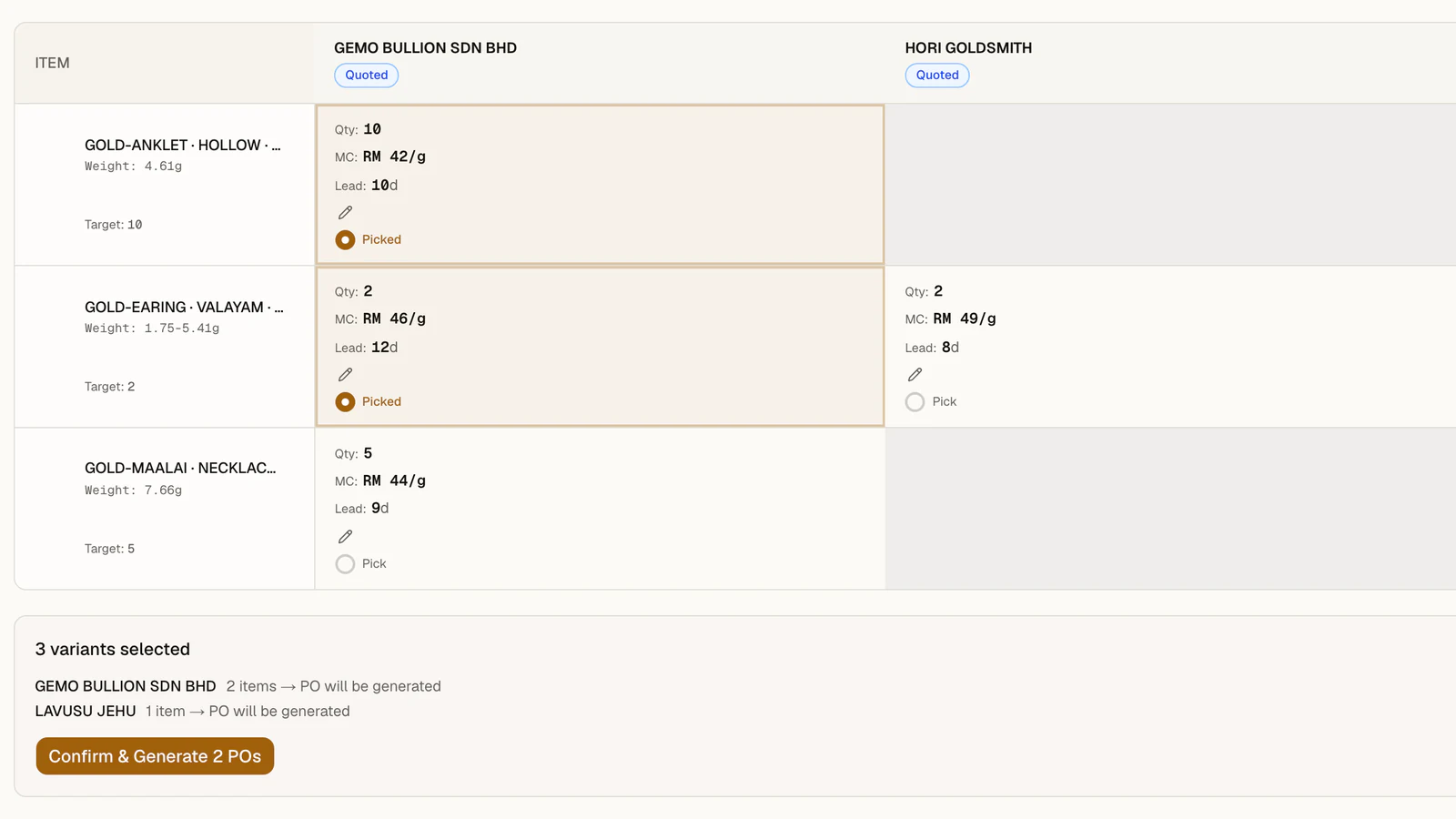
For a jewelry group in Malaysia with three brands and about 11,000 SKUs, we kept their ERP and built a restocking tool beside it: tracking rules, fast sellers, supplier quotes through secure links, and purchase orders.